
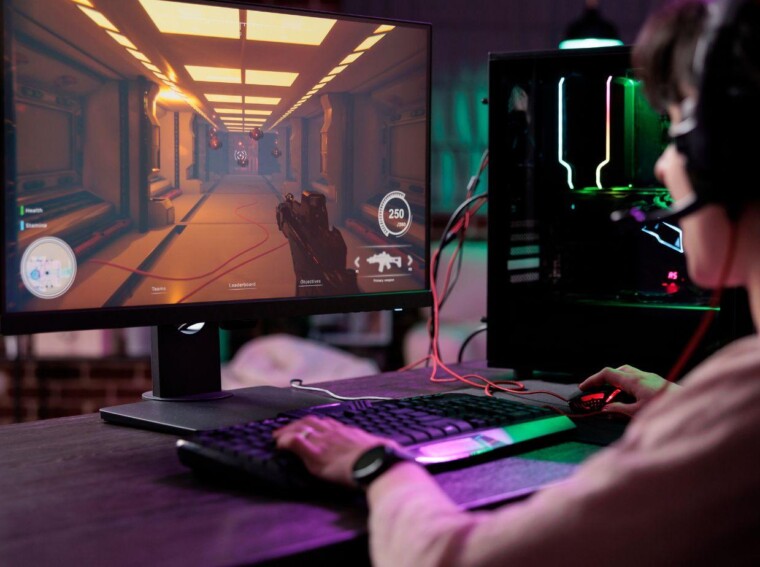
Gaming setups have become genuinely sophisticated. High refresh rate monitors, mechanical keyboards, low-latency peripherals, purpose-built chairs. Most of that investment goes into what happens on screen. Almost none of it goes into the interface between the screen and the eyes, which is where most of the physical cost of long sessions actually accumulates.
Gaming glasses exist to address that gap. But the category has enough variation in quality, specification, and marketing noise that knowing what actually matters before buying saves money and prevents the disappointment of a pair that underdelivers.
Blue Light Filtering: The Core Function
Screens emit a disproportionate amount of short-wavelength blue light compared to natural light sources. Gaming monitors, which typically run at higher brightness and contrast settings than office displays, sit at the more demanding end of the spectrum. Over a long session, the visual processing effort that blue light demands accumulates into the eye fatigue and difficulty sleeping that most regular gamers experience without connecting to the light itself.
A blue light filter is the foundational feature of any gaming glasses worth buying. Quality pairs filter between 30 and 50 percent of blue light. That range covers the wavelengths most associated with eye fatigue and melatonin suppression without distorting colour perception to the point of affecting gameplay. Higher filtering percentages often come with a more pronounced amber tint, which enhances warm tones and can improve contrast in certain environments but affects colour accuracy in games where precise colour reading matters.
For most gamers, a clear or very lightly tinted lens with 30 to 40 percent blue light filtering is the most practical balance.
Anti Glare Coating: Non-Negotiable
Anti glare glasses have an anti-reflective coating applied to the lens surface that eliminates the secondary reflections created by room lighting, the monitor itself, and any other light sources in the gaming environment. These reflections are not dramatically visible as individual distractions. They register as low-level visual noise that the brain manages continuously across a session, contributing to the fatigue that builds over hours in a way that is difficult to attribute to any single cause.
Anti-reflective coating on a gaming lens removes this load entirely. It is one of the most evidence-backed interventions for reducing screen-related visual fatigue and should be considered a standard requirement rather than an optional feature. Any gaming glasses worth buying include it. Any pair that does not is missing one of the more practically significant elements of the product category.
Lens Tint and Colour Accuracy
The amber or yellow tint found in many gaming glasses is designed to enhance contrast by boosting the warm end of the colour spectrum and reducing the cool blue cast of most monitor displays. Some gamers find this genuinely useful, particularly in games with dark environments where contrast between shadows and surfaces is visually important.
The trade-off is colour accuracy. Games with detailed colour environments, design and creative work done on a monitor, or any application where colour precision matters will look different through a heavily tinted lens. The warm cast that enhances contrast in one context distorts colour in another.
For gamers whose sessions mix different types of content, a lightly tinted or clear lens with blue light filtering provides the fatigue reduction benefit without committing to the colour shift that heavier amber tints produce. For gamers whose sessions are predominantly in games where contrast enhancement is genuinely useful and colour accuracy is less critical, a moderate amber tint is a reasonable choice.
Prescription Integration
This is where many gaming glasses briefs stop, but for the significant proportion of gamers who wear prescription glasses, it is the most practically important feature consideration of all.
Standard prescription lenses are optimised for distance or near vision. The screen distance, typically 60 to 80 centimetres from the face, sits in an intermediate zone that neither distance nor standard reading prescription handles optimally. Gaming through a prescription calibrated for the wrong distance means the eye is compensating continuously, which contributes directly to the digital eye strain that accumulates across long sessions.
Prescription gaming glasses, with the correction optimised for the screen distance and blue light filtering incorporated into the lens, address both issues simultaneously. They are available online through established UK optical retailers, and the price difference between a prescription and non-prescription gaming lens is not as significant as many people assume before checking.
For prescription wearers who have been using non-prescription gaming glasses over contact lenses, or simply wearing standard prescription frames during gaming, purpose-built prescription gaming glasses are one of the more significant practical upgrades available.
Frame Fit for Long Sessions
A frame that is comfortable for a fifteen-minute wear can become genuinely uncomfortable across a four-hour gaming session. Temple pressure, nose bridge weight, and the heat that builds under a heavier frame are all factors that standard optical frame reviews do not capture but that matter considerably during extended use.
Lightweight materials, titanium and quality thin acetate, reduce the cumulative weight load across a long session. Adjustable nose pads allow the bridge position to be set correctly for the wearer’s specific nose geometry rather than accepting a fixed position that may not suit their face. Silicone temple tips maintain grip and reduce pressure across extended wear better than hard plastic alternatives.
The frame should also be wide enough to sit without pressing against the temples while still maintaining the lens position in front of the eye. A frame too narrow for the face will press inward progressively during a long session. A frame too wide will slide and require constant adjustment.
What to Avoid
A few features that appear in gaming glasses marketing deserve scepticism.
Very high blue light filtering percentages above 60 or 70 percent come with significant colour distortion that is likely to detract from the gaming experience rather than improve it, and there is no evidence that the additional filtering benefit above 50 percent justifies this trade-off for typical gaming use.
Lenses marketed primarily on contrast enhancement without specifying their blue light filtering percentage and anti-reflective coating status may be emphasising the aesthetic feature at the expense of the functional ones.
And any pair without anti-reflective coating, however good the blue light filtering specification, is missing the feature that contributes most consistently to reducing screen-related eye fatigue across long sessions.
The Bottom Line
The gaming glasses category has genuine products and a lot of marketing noise. The features that consistently deliver: blue light filtering in the 30 to 50 percent range, quality anti-reflective coating on both lens surfaces, appropriate tint level for the type of content being viewed, prescription integration if needed, and a lightweight frame built for extended wear. Everything else is secondary to getting those five things right.