
Gamers are used to reading numbers before they commit. You check a legendary drop rate, compare weapon stats, or read patch notes to see what changed. Slot games hide a similar set of numbers behind an info screen that most players never open. Two of them, RTP and volatility, explain a lot about how a session will feel.
Odds disclosure is already normal in gaming
Randomized rewards have been under scrutiny for years. Apple’s App Store review guidelines say that apps offering loot boxes or other randomized virtual items for purchase must disclose the odds of receiving each type of item before the player buys. The idea is simple: if chance is part of the product, the numbers should be visible.
RTP is the casino version of that disclosure. It’s a published percentage, and you can check it before you play.
What RTP actually means
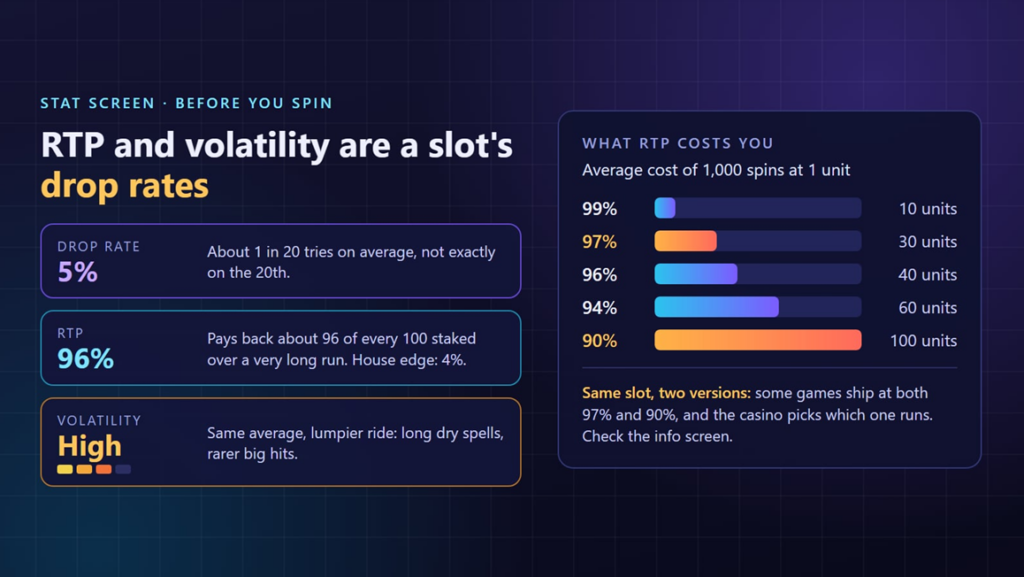
RTP stands for return to player. A slot with a 96% RTP is designed to return about 96 units for every 100 staked, averaged over a very large number of spins. The remaining 4% is the house edge, which is the average cost of playing.
The key word is average. A drop rate of 5% doesn’t mean you get the item on exactly the 20th try, and RTP works the same way. A single session can land far above or far below the figure.
RNG and RTP do different jobs
These two terms often get mixed up. The random number generator (RNG) decides the outcome of each individual spin. RTP is the long-run payout rate the game was built around. Independent testing agencies such as eCOGRA check that a game’s RNG is unbiased and that its real-world payout matches the designed RTP. Regulated markets require this kind of testing, which is a good reason to play only at licensed operators. Casinofy’s guide to online casinos in Europe shows the licence each one holds, so you can check before you sign up.
Volatility is the difficulty setting
Two slots can share the same RTP and feel completely different, because of volatility:
- Low volatility: smaller wins arrive often, and balances move gradually.
- High volatility: long dry spells are common, and the larger hits are rarer.
Think of it as variance. A high-volatility game doesn’t pay more on average. It pays the same average in a lumpier way. Match it to your budget: a small bankroll lasts longer on a low-volatility game.
What RTP costs you
RTP converts directly into an average cost. At a 1-unit stake over 1,000 spins:
| RTP | House edge | Average cost |
| 99% | 1% | 10 units |
| 97% | 3% | 30 units |
| 96% | 4% | 40 units |
| 94% | 6% | 60 units |
| 90% | 10% | 100 units |
Every point of RTP is worth about 10 units per 1,000 spins at that stake. It looks small per spin but adds up over a long session.
The same game can have different RTPs
This is the part that surprises most gamers. Some studios release one slot in several RTP versions, and each casino chooses which one to run. Quickspin’s Big Bad Wolf, for example, is published at both 97% and 90%. It’s the equivalent of two servers running different drop-rate configs under the same game title.
So don’t assume the RTP you read about is the one you’re playing. Open the game’s help or info screen and check the percentage for that version.
A quick checklist before you play
Knowing the numbers won’t change the odds, but it will change how you read a session. Reading the stat screen is a habit gamers already have, and it works here too.
Gambling is for adults aged 18 and over. Set limits, never chase losses, and seek free, confidential support from GamCare or BeGambleAware if gambling stops being fun.