
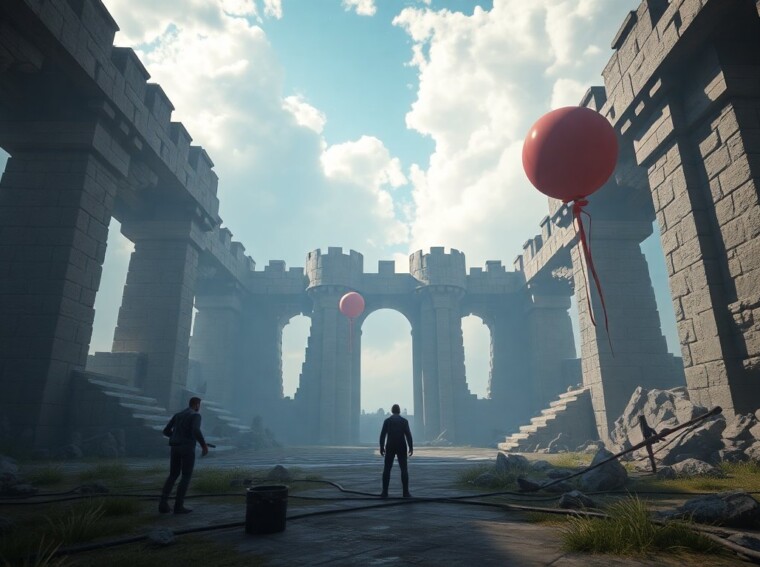
Playmyworld.com all gaming start as a new esports mode in 2026. PMRLD builds the mode to test stealth, timing, and team sight. Players join short matches in ruins that force silent moves and clever detection. The mode mixes simple rules with hidden objects to reward observation and coordination.
Key Takeaways
- PMRLD Invisible Balloon Wars in the titanium castle ruins is a new esports mode launching in 2026 that emphasizes stealth, timing, and team coordination.
- Players navigate a multi-layered, sound-sensitive titanium fortress map where invisible balloons are detected through subtle audio and environmental cues.
- Match types vary to test different skills, with rounds focusing on balloon popping, escorting beacons, and zone clearing.
- Effective team play involves assigned roles like scouts and anchors, strategic use of limited detection tools, and controlled movement to avoid false signals.
- Environmental hazards and interactive terrain require adaptive strategies rather than predictable routes, rewarding map knowledge and pattern recognition.
- Broadcast-friendly design includes short rounds and clear communication protocols that enhance viewer engagement without revealing balloon positions.
What Are PMRLD Invisible Balloon Wars? Setting, Lore, And Match Types
PMRLD invisible balloon wars in titanium castle ruins place players inside a broken fortress made of titanium. The developer sets the map as a reclaimed arena that keeps scattered defenses and collapsed towers. The lore states that a research group used the site to test lightweight containment devices. Players find old labs, sunken parapets, and narrow corridors.
Matches run in short rounds. Each round gives a clear objective. In standard rounds, teams race to pop the most invisible balloons. In escort rounds, a team must move a visible beacon through the ruins while opponents try to force a misstep by popping hidden balloons. In timed rounds, players score by clearing marked zones that may hide balloons.
The mode aims for fast, repeatable play. PMRLD balances round length for broadcast use and casual sessions. Spectator tools show limited hints to viewers while keeping player vision blind to the balloons. This setup lets casters highlight strategy without spoiling the core tension.
Match types reward different skills. Solo skirmish tests raw sensing and movement. Duo play relies on cross-checks and simple callouts. Full teams use set roles like scout, bait, and anchor. PMRLD tunes each match type with small rule shifts, such as balloon respawn timers and detection sensitivity, to keep variety high.
Core Mechanics, Invisible Balloons, And The Titanium Castle Ruins Map
PMRLD invisible balloon wars in titanium castle ruins use three core mechanics: invisibility, subtle signposting, and interactive terrain. Balloons remain visually absent to players. The game gives small audio cues and environmental reactions to mark a balloon location. Players learn to read dust puffs, light flares, and tile vibrations.
The map design gives many vertical layers. Ruins include low tunnels, collapsed bridges, and high battlements. The titanium material affects sound. Footsteps ring differently on metal than on stone. Players use that difference to estimate opponent positions and possible balloon sites. PMRLD calibrates audio to support this reading without making detection trivial.
Movement plays a large role. Sprinting creates louder noise and stronger tile reactions. Crouch walking cuts noise and reduces visual disturbances. The game sets a penalty if a player repeatedly triggers noisy actions near the same site. This penalty encourages varied movement and makes camping a weaker tactic.
Detection tools remain limited. Teams receive one short-range scanner that gives a fuzzy direction to the nearest balloon. The scanner requires line-of-sight to point reliably. PMRLD adds consumables that create temporary light pulses or localized sound bursts to flush a balloon’s reaction. Players must weigh using a consumable now versus saving it for a late round push.
The titanium castle ruins include zones with environmental hazards. Some rooms contain magnetized floors that shift balloon positions slightly. Other areas house wind vents that move balloon signatures. These elements force adaptation rather than rote paths. Map knowledge and pattern memory consistently give a competitive edge.
For historical context, PMRLD designers cite other indie action titles as soft influences. An interview about modern platform development highlights similar visual and design goals, which influenced some aesthetic choices in the ruins during early production stages, as seen in a published Hirogami interview.
Advanced Strategies: Movement, Detection, And Team Play To Win In The Ruins
Teams that win PMRLD invisible balloon wars in titanium castle ruins plan roles and practice simple signals. They assign a scout to probe and a second player to confirm findings. The scout moves with low noise. The confirmer brings a scanner or a light consumable. The team trades short, direct callouts to reduce clutter.
Movement strategy focuses on flow. Players avoid repeating the same approach to a zone. They alternate entry points and use timed distractions to force opponents to reveal balloon reactions. Teams time their pushes to match consumable cooldowns. They create windows where multiple tools overlap for clearer detection.
Detection strategy favors layered checks. A player marks a likely spot after a faint clue. A teammate then uses a scanner or a pulse to test the mark. If the reaction matches, the team converges and secures the balloon. If the reaction fails, the team withdraws and maps the false positive for later rounds. This process turns uncertain signals into reliable information.
Anchor roles guard objectives. An anchor holds a chokepoint and relays movement cues. Anchors place small traps or noise makers that cause balloons to react if an opponent moves carelessly. These traps serve as early warning systems rather than lethal tools.
Timing beats raw speed in many cases. Players who rush often trigger multiple false signals and waste consumables. Teams that pace their advance and force the opponent to act first gain value from each detection tool. PMRLD’s scoring favors controlled discovery over chaotic sprinting.
Practice routines remain simple and repeatable. Teams run dry drills that isolate one mechanic, such as silent movement or scanner timing. They log common false cue locations and create a short list of high-probability zones. Over time, the team builds a shared map of typical balloon behavior in the ruins.
Broadcast play adds a layer of preparation. Teams plan callouts that sound good on air and communicate quickly. Casters benefit when teams use clear, consistent language. This clarity improves viewer engagement and helps players keep focus under pressure.