
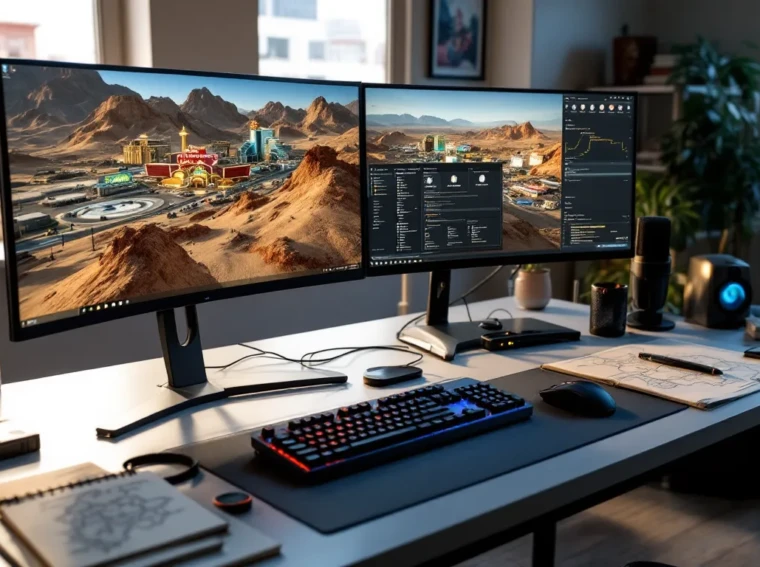
Fallout: New Vegas remains a fan favorite nearly 17 years after its release, beloved for its branching narrative, morally gray factions, and the distinctive writing that set it apart from other entries in the series. But what if you could experience that same story with the upgraded gameplay mechanics, weapon customization, and visual fidelity of Fallout 4? That’s exactly what the Fallout 4: New Vegas project aims to deliver, a total conversion mod rebuilding the entire Mojave Wasteland experience inside Fallout 4’s engine. This isn’t a simple texture pack or balance tweak: it’s an ambitious community-driven effort to recreate one of the most celebrated RPGs of all time from the ground up. Whether you’re a New Vegas veteran eager to revisit the Strip or a Fallout 4 player curious about what you missed, this project represents one of the most significant fan undertakings in gaming history.
Key Takeaways
- Fallout 4: New Vegas is a total conversion mod that faithfully recreates the entire Fallout: New Vegas experience within Fallout 4’s engine, combining the original’s branching narrative and faction systems with modern gameplay mechanics and visuals.
- The mod features significant technical improvements over the original, including responsive gunplay, enhanced AI pathfinding, physically-based rendering for realistic graphics, and a restored classic dialogue interface to preserve meaningful speech checks.
- All main and side quests, eight companions, the iconic Mojave Wasteland map at 1:1 scale, and the faction reputation system are being fully recreated to maintain authenticity and narrative fidelity for both veterans and newcomers.
- A realistic release window for Fallout 4: New Vegas is estimated between late 2027 and early 2029, with the team prioritizing a complete, polished release that includes all main questlines and four DLC expansions before any public launch.
- The project requires a clean Fallout 4 installation and system specifications slightly exceeding vanilla Fallout 4, with recommended hardware including an RTX 2070 or equivalent GPU and 32GB RAM for optimal performance.
- Fallout 4: New Vegas demonstrates the vitality of single-player modding communities and serves as a case study in game preservation, keeping beloved titles accessible and relevant as technology advances without official remasters from publishers.
What Is Fallout 4: New Vegas?
Fallout 4: New Vegas (often abbreviated as F4NV) is a total conversion mod that recreates the entire Fallout: New Vegas experience within Fallout 4’s Creation Engine. Unlike smaller mods that add weapons or quests, this project rebuilds the entire game, every quest, location, character, weapon, and piece of dialogue, using Fallout 4 as the foundation.
The mod is developed by a dedicated team of volunteer modders, artists, voice actors, and writers who’ve been working on the project since 2017. It’s completely free and non-commercial, which keeps it in legal safe territory as a transformative fan work.
Understanding the Project’s Origins and Goals
The project launched in early 2017, inspired by similar ambitious conversion mods like Fallout 3’s “Tale of Two Wastelands” and Skyrim’s “Skyblivion.” The team’s goal was straightforward but monumental: preserve everything that made New Vegas special while leveraging Fallout 4’s technical improvements.
The development philosophy centers on authenticity. The team isn’t reimagining New Vegas, they’re faithfully recreating it. Every line of dialogue from the original game is being re-recorded by voice actors (since using Bethesda’s original audio files would violate copyright). Quests are being rebuilt to function identically to their 2010 counterparts, maintaining the same branching paths, skill checks, and consequences.
This commitment to accuracy extends to the small details. The team has meticulously documented the original game’s layouts, NPC placements, and item distributions to ensure the remake feels authentic to veterans while introducing newcomers to the unmodified New Vegas experience.
How It Differs from the Original Fallout: New Vegas
While F4NV aims for narrative and content fidelity, the gameplay will feel noticeably different due to Fallout 4’s engine. The most significant change is gunplay, Fallout 4’s shooting mechanics are objectively tighter and more responsive than New Vegas’s floaty, VATS-dependent combat. Players who felt New Vegas’s shooting was its weakest element will appreciate the upgrade.
The mod will also incorporate Fallout 4’s improved AI pathfinding, which means companions and NPCs won’t constantly get stuck on terrain or struggle with basic navigation. The visual upgrade is substantial too, with modern lighting, higher-polygon models, and better texture resolution throughout the Mojave.
But, some systems won’t make the transition. Fallout 4’s dialogue system famously replaced New Vegas’s full-text dialogue trees with a simplified four-option wheel. The F4NV team has implemented custom UI modifications to restore the classic dialogue interface, ensuring players see exactly what their character will say before committing to a choice, a critical element for New Vegas’s speech-check-heavy gameplay.
Current Development Status and Release Timeline
Latest Updates and Milestones Achieved
As of March 2026, Fallout 4: New Vegas remains in active development with significant progress across multiple fronts. The team regularly posts development updates on their official Discord and social media channels, showcasing completed assets and systems.
Recent milestones include the completion of the Lucky 38 casino’s interior, full implementation of the reputation system (a cornerstone of New Vegas’s faction dynamics), and the recreation of over 60% of the game’s unique weapons. The voice acting effort has recorded approximately 40% of the game’s dialogue, with the team actively recruiting volunteer voice actors for remaining roles.
The world space recreation is particularly impressive, the entire Mojave Wasteland map has been rebuilt in Fallout 4’s engine, including iconic locations like Goodsprings, the New Vegas Strip, Freeside, and Hoover Dam. Environmental artists have painstakingly recreated the desert atmosphere, including the distinctive orange-tinted lighting that gave the original its memorable visual identity.
Several gameplay systems are already functional in internal builds, including the hardcore mode survival mechanics, weapon mod system adaptations, and the Caravan card game. According to community modding platforms, projects of this scope typically show accelerated progress once core systems are established, and F4NV appears to have reached that inflection point.
When Can You Expect to Play?
The development team has consistently avoided committing to a specific release date, and for good reason. Total conversion mods of this magnitude often take 7-10 years to complete, and F4NV is tracking within that range.
Based on current progress reports and the team’s transparency about remaining work, a realistic estimate places a public release somewhere between late 2027 and early 2029. The team has stated they won’t release until the main questline and all four DLC expansions (Dead Money, Honest Hearts, Old World Blues, and Lonesome Road) are fully playable.
There won’t be an early access or beta release for the general public. The team plans a complete, polished release to avoid the fragmented experience of incomplete builds. But, they’ve mentioned the possibility of releasing standalone components, like weapon packs or the reputation system, as separate mods before the full conversion launches.
Key Features and Improvements Over the Original
Enhanced Graphics and Visual Upgrades
The visual leap from 2010 to 2026 is substantial. F4NV leverages Fallout 4’s physically-based rendering (PBR) system, which delivers more realistic material surfaces, metals look metallic, weathered wood shows proper texture depth, and lighting interacts with surfaces in believable ways.
The Mojave Desert benefits enormously from improved draw distances and level-of-detail systems. In the original New Vegas, distant terrain often appeared as flat, low-resolution textures. The remake renders far-off mountains, buildings, and landmarks with significantly more detail, making the wasteland feel more expansive and lived-in.
Character models receive perhaps the most dramatic upgrade. The original’s somewhat stiff, plasticky character faces are replaced with Fallout 4’s more expressive facial systems, allowing for better emotional range during dialogue sequences. Subtle animations like breathing, idle fidgets, and reactive expressions make conversations feel more dynamic.
Improved Gameplay Mechanics from Fallout 4
Fallout 4’s core gameplay improvements translate directly into a better moment-to-moment experience in the Mojave. The gunplay feels responsive and satisfying without relying entirely on VATS for accuracy. Aiming down sights (ADS) works smoothly, recoil patterns are predictable, and hit detection is reliable.
The looting and inventory systems are more intuitive, with a streamlined interface that doesn’t require multiple menu transitions to transfer items. The Pip-Boy menu, while stylistically similar, features quality-of-life improvements like better sorting options and faster navigation.
Stealth mechanics are notably improved as well. Fallout 4’s detection system provides clearer feedback through the bracket indicator, showing exactly when enemies are about to spot you. This makes stealth builds more viable and less frustrating than the original’s sometimes inconsistent detection.
Players who enjoyed the power armor mechanics in Fallout 4 will find similar systems adapted for New Vegas’s armors, though the scarcity of power armor in the Mojave maintains the original’s balance.
Weapon Customization and Crafting Systems
One of Fallout 4’s standout features was its modular weapon customization, and F4NV adapts this system to New Vegas’s arsenal. Weapons like the hunting rifle will feature multiple receiver, barrel, stock, and sight options, allowing players to tailor their favorite guns to specific playstyles.
The team is carefully balancing this system to respect New Vegas’s original design philosophy. You won’t find the same degree of wild modification possibilities as Fallout 4, instead, the options reflect what would realistically exist in the Mojave’s weapon ecosystem. A 9mm pistol might receive different grip, barrel, and sight configurations, but it won’t transform into a completely different weapon class.
Crafting stations will support ammunition crafting (a beloved New Vegas feature absent from base Fallout 4), weapon repair, and modification. The team has also implemented the Workbench and Reloading Bench systems from the original, maintaining the resource-management aspect that made hardcore mode challenging.
Settlement Building in the Mojave Wasteland
This is perhaps the most controversial addition to the remake. Fallout 4’s settlement system defined much of its gameplay loop, but New Vegas was designed without it. The F4NV team is taking a measured approach.
Settlement building will be available but limited to specific locations that make narrative sense, places like Red Rocket stations or certain player-owned properties mentioned in quests. You won’t be able to build settlements at every workshop-enabled location like in Fallout 4.
The system serves more as a housing customization feature than a core gameplay pillar. Players can personalize their Vegas suite at the Lucky 38 or upgrade their Novac motel room, but they won’t be managing a network of interconnected settlements with supply lines and recruitment mechanics. This preserves New Vegas’s focus on exploration and narrative rather than base-building.
What Content from New Vegas Is Being Recreated?
Story, Quests, and Faction Systems
Every main quest, side quest, and random encounter from the original game is being recreated with full fidelity. This includes the branching main storyline where players choose between supporting Mr. House, the NCR, Caesar’s Legion, or an independent New Vegas.
The faction reputation system, arguably New Vegas’s most defining mechanical feature, is fully implemented. Your actions toward the NCR, Legion, Powder Gangers, Brotherhood of Steel, and other factions will affect how they perceive and interact with you. Wear Legion armor in NCR territory, and you’ll be treated as an enemy. Help the Khans, and they’ll remember your assistance.
All companion quests are being recreated, including the personal storylines for Boone, Veronica, Arcade, Cass, Raul, and Lily. The companion wheel interface is being adapted to work within Fallout 4’s command system, giving players the same tactical control they had in the original.
Skill checks and Speech challenges remain intact, though adapted to work with Fallout 4’s perk system. The team has created a hybrid SPECIAL/skill system that preserves New Vegas’s check-based dialogue and quest solutions while leveraging Fallout 4’s perk framework.
Iconic Locations and Map Recreation
The entire Mojave Wasteland map has been painstakingly recreated at 1:1 scale. This includes not just major cities like New Vegas and Primm, but also smaller locations like the REPCONN test site, Camp McCarran, the Ultra-Luxe casino, and Vault 22.
Each location maintains its original layout and environmental storytelling. The eerie abandoned vaults, the opulent casinos of the Strip, the ramshackle settlements scattered across the desert, all are being rebuilt with enhanced visual fidelity but identical spatial design. Veterans of the original will be able to navigate from memory.
The team has paid special attention to recreating the Strip’s unique atmosphere. The original New Vegas had to split the Strip into separate cells due to console limitations, breaking immersion with loading screens. F4NV maintains those divisions for performance and authenticity reasons, but the improved loading times on modern hardware make transitions nearly seamless.
Weather systems and ambient audio have been upgraded as well. Desert sandstorms, the distant sound of Strip music bleeding into Freeside, and the ambient wildlife sounds all contribute to a more immersive Mojave experience.
Companions and Character Interactions
All eight of New Vegas’s companions are being recreated with updated character models and fully re-recorded dialogue. The voice acting team has worked to match the original performances while taking advantage of better audio recording technology.
Companion AI benefits from Fallout 4’s improvements, meaning your followers will actually use cover, won’t trigger every trap, and can navigate complex terrain without constant babysitting. Combat-oriented companions like Boone and Veronica will be noticeably more effective thanks to better pathfinding and combat behavior.
The affinity system from Fallout 4 is being adapted to work with New Vegas’s companion quest structure. Instead of the gradual affinity gains from Fallout 4, companions will react to specific quest decisions and dialogue choices that align with their personal beliefs and backgrounds.
Romance options remain exactly as they were in the original, which is to say, limited to specific dialogue exchanges rather than Fallout 4’s more explicit romance mechanics. The team is preserving the original’s subtler approach to character relationships.
System Requirements and Installation Guide
PC Requirements You’ll Need
Since F4NV is a total conversion mod for Fallout 4, you’ll first need a legitimate copy of Fallout 4 on PC. Console versions won’t be compatible due to script and asset limitations on PlayStation and Xbox platforms.
Based on current development builds and similar total conversion projects, expect system requirements to slightly exceed vanilla Fallout 4’s demands:
Minimum Requirements (30 FPS at 1080p, low-medium settings):
- CPU: Intel Core i5-4690 or AMD Ryzen 3 1200
- GPU: NVIDIA GTX 1060 6GB or AMD RX 580 8GB
- RAM: 16GB
- Storage: 80GB available space (includes base game and mod files)
- OS: Windows 10 64-bit or later
Recommended Requirements (60 FPS at 1080p, high settings):
- CPU: Intel Core i7-8700K or AMD Ryzen 5 3600
- GPU: NVIDIA RTX 2070 or AMD RX 5700 XT
- RAM: 32GB
- Storage: 100GB SSD space
- OS: Windows 11 64-bit
These are estimates based on similar projects covered by gaming news outlets and may change as optimization continues. The team has stated performance is a priority, and they’re working to ensure the mod runs as efficiently as possible on mid-range hardware.
How to Install the Mod When It Releases
While the exact installation process won’t be finalized until release, the team has outlined the general procedure based on standard modding practices:
-
Ensure a clean Fallout 4 installation – Start with an unmodded or lightly modded installation. The team recommends a fresh install to avoid conflicts.
-
Download a mod manager – Tools like Mod Organizer 2 or Vortex will be required. Manual installation won’t be supported due to the mod’s complexity.
-
Download F4NV and required dependencies – The mod will likely be distributed in multiple archive files due to its size. Additional script extenders and framework mods may be required.
-
Install through your mod manager – Follow the specific load order instructions provided by the team. Load order will be critical for stability.
-
Run the game through the mod manager – Don’t launch through Steam directly, as this may bypass necessary script extenders.
The team plans to release comprehensive installation guides and video tutorials alongside the mod. They’re also considering a streamlined installer similar to other major modding projects to simplify the process for less experienced modders.
The Development Team Behind the Project
Fallout 4: New Vegas is developed by a volunteer team of over 100 contributors spread across the globe. Unlike commercial development studios with hierarchical structures, the F4NV team operates more like an open-source software project, with contributors joining and leaving based on availability and interest.
The core leadership consists of project managers, lead developers, and department heads for areas like 3D modeling, level design, programming, writing, and voice acting. These leads coordinate work, maintain quality standards, and ensure different departments stay aligned with the overall vision.
Team members come from diverse backgrounds. Some are industry professionals working on F4NV in their spare time, while others are talented amateurs using the project to build portfolio pieces. Several team members have gone on to professional game development positions, with F4NV work serving as a compelling demonstration of their skills.
The project maintains an open recruitment policy. Anyone with relevant skills can apply to join, and the team regularly posts recruitment calls for specific roles, voice actors for particular characters, 3D artists for weapon models, or programmers for specific gameplay systems. This decentralized approach keeps the project moving even as individual contributors’ availability fluctuates.
Communication happens primarily through Discord, with regular voice meetings for department coordination and progress reviews. The team has established detailed documentation standards and asset pipelines to ensure consistency across hundreds of individual contributions.
Community Challenges and Legal Considerations
The biggest ongoing challenge is sustainability. Volunteer projects face constant turnover as contributors’ life circumstances change. People get new jobs, have children, move, or simply lose interest. The F4NV team has built organizational resilience to handle this, with detailed documentation that allows new contributors to pick up where others left off.
Scope creep is another concern. With so many passionate contributors, there’s constant temptation to expand beyond the original vision, adding new quests, creating original content, or significantly altering systems. The leadership has remained disciplined about staying faithful to the original New Vegas experience, sometimes disappointing contributors who want to “improve” rather than recreate.
Technically, the Creation Engine presents persistent challenges. It’s a notoriously finicky engine, prone to crashes and strange bugs when pushed beyond its intended limits. The team has had to develop custom tools and workarounds for systems the engine wasn’t designed to handle, particularly around the complex faction reputation mechanics.
Legally, F4NV operates in a somewhat gray area, though one with established precedent. The project doesn’t use any copyrighted assets directly, all voice acting is re-recorded, all 3D models are rebuilt from scratch, and no code is copied from New Vegas. What they’re recreating is the game’s design, which isn’t protected in the same way.
Bethesda and Obsidian have remained silent on the project, which the modding community generally interprets as tacit approval. The company has a long history of tolerating and even celebrating ambitious fan projects, as long as they don’t charge money or use assets inappropriately. The F4NV team is careful to require players to own both Fallout 4 and Fallout: New Vegas, ensuring proper licensing.
The bigger legal risk would be takedown requests from voice actors or writers who worked on the original game, though this is unlikely since all content is being recreated rather than copied. The team maintains regular legal consultations and has contingency plans if any IP issues arise.
Why This Matters for Fallout Fans
Fallout: New Vegas and Fallout 4 represent two distinct design philosophies within the same franchise. New Vegas prioritized branching narratives, meaningful choices, and deep RPG systems. Fallout 4 emphasized improved combat, base building, and environmental storytelling. Each has strengths the other lacks, and fans have debated their relative merits for over a decade.
F4NV offers something unprecedented: the narrative depth of New Vegas with the mechanical polish of Fallout 4. For players who struggled with New Vegas’s clunky shooting but loved its story, this is the definitive way to experience the Mojave. For those who mastered Fallout 4’s combat but found its dialogue limiting, F4NV provides the complex conversations and moral ambiguity they craved.
The project also demonstrates the enduring vitality of single-player modding communities. In an era dominated by live-service games and tightly controlled ecosystems, projects like F4NV prove that passionate communities can create transformative experiences without corporate backing. Players who appreciate extensive mod support understand how much value these communities bring to games.
For the broader gaming industry, F4NV serves as a case study in preservation and remastering. Obsidian and Bethesda are unlikely to officially remaster New Vegas anytime soon, the business case isn’t compelling enough. Fan projects like this ensure beloved games remain accessible and relevant as technology advances.
There’s also significant educational value. Aspiring game developers can study F4NV’s development process, learn from the team’s technical solutions, and understand the massive scope of what goes into creating a game of this complexity. The project’s transparency about challenges and solutions provides insights rarely available from commercial development.
Conclusion
Fallout 4: New Vegas represents one of the most ambitious fan projects in gaming history, a complete recreation of a beloved RPG using a newer engine’s technical capabilities. While the release date remains uncertain, the steady progress, dedicated team, and proven track record of similar conversion mods suggest this project will eventually deliver on its promise.
For Fallout fans, it’s worth keeping an eye on development updates and preparing for what could be the definitive way to experience the Mojave Wasteland. Make sure you own both Fallout 4 and Fallout: New Vegas on PC, consider upgrading your hardware if you’re running older components, and familiarize yourself with basic modding tools. When F4NV eventually releases, you’ll want to be ready to explore the Strip, navigate faction politics, and decide the fate of New Vegas all over again, this time with modern graphics, responsive gunplay, and all the improvements a decade of engine development has brought.