
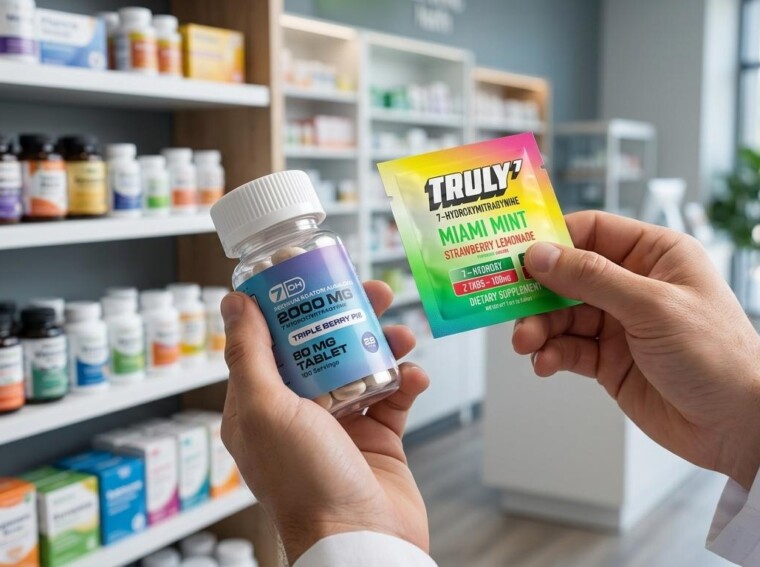
Few topics in the kratom market have produced as many questions this year as federal action on 7-hydroxymitragynine. Store owners, 7oh resellers, shoppers and even employers want to know the same things: what has actually been scheduled, what is still only proposed, and what any of it means at the state level. The 7oh ban is often talked about as if it were a single event, but the federal process has moved in stages, and the details matter. This guide walks through the timeline as of early October 2026, explains the difference between a notice of intent and a temporary order, and sets out what to watch next.
Why 7-OH Became a Regulatory Target
7-hydroxymitragynine, usually shortened to 7-OH, is one of many alkaloids found in the leaves of Mitragyna speciosa, the plant commonly called kratom. In the natural leaf it appears only in small amounts. Over the past few years, however, a large retail category grew around concentrated 7-OH products sold as tablets, shots, powders and other formats.
Regulators drew a line between the leaf and these concentrated products. On July 29, 2025, the U.S. Food and Drug Administration announced that it was recommending that concentrated 7-OH products be scheduled under the Controlled Substances Act. That recommendation went through the Department of Health and Human Services to the Drug Enforcement Administration, which is the agency that actually places substances into federal schedules.
The 2026 Federal Timeline
The process picked up speed in the summer of 2026. Here is the sequence in plain terms:
• July 1, 2026: The DEA announced its intent to temporarily schedule 7-OH and three related compounds.
• July 6, 2026: Two notices of intent were published in the Federal Register. One covered 7-OH above a specified threshold. The other covered mitragynine pseudoindoxyl (often shortened to MP), MGM-15 and MGM-16.
• August 5, 2026: This was the earliest date a temporary order could take effect, because federal law requires at least 30 days of notice before a temporary scheduling order is issued.
• August 26, 2026: The DEA published a temporary order placing MP, MGM-15 and MGM-16 in Schedule I, effective the same day.
• September 10, 2026: A reopened public comment period on the related Health and Human Services docket closed.
As of early October 2026, no temporary order for 7-OH itself had been published in the Federal Register. That means 7-OH above the proposed threshold was still proposed for control rather than controlled. Because a final order can be published on any business day, anyone relying on this information should check the Federal Register directly before making decisions.
What the Proposed Threshold Means
The 7-OH notice does not target every trace of the alkaloid. Its title refers to 7-OH "above a specified threshold." The published proposal sets that threshold at 0.050 percent 7-OH by dry weight for kratom plant material, and at 0.050 percent or 1.00 milligram for processed products such as extracts, concentrates and pressed tablets. The intent is to separate naturally occurring leaf, where 7-OH is present only in small amounts, from products that have been concentrated well beyond natural levels.
If the order is published in its proposed form, products above those thresholds would fall under Schedule I controls, whatever their format. Plant material below the threshold would not be covered by this particular action. The exact wording of any final order will be what counts, so it is worth reading the published text rather than relying on summaries, including this one.
What Is Not Covered by Federal Action
Two points cause a lot of confusion, so they are worth stating clearly.
First, the federal actions so far do not schedule kratom leaf itself. Second, they do not schedule mitragynine, the most abundant alkaloid in most kratom leaf. The three compounds that are now in Schedule I (MP, MGM-15 and MGM-16) are lab-derived compounds related to 7-OH, and the pending 7-OH order is aimed at concentrated material above the threshold.
None of that means kratom is unregulated. It only means that, at the federal level, the leaf and mitragynine sit outside these specific orders.
State and Local Rules Still Matter
Federal status is only half of the picture. Several states have passed their own laws restricting kratom, 7-OH or both, and some counties and cities have local rules that are stricter than their state. A product that is lawful at the federal level can still be prohibited where a person lives.
That is why responsible online retailers maintain shipping exclusion lists and update them as laws change. Anyone asking where is 7oh legal should treat a retailer's list as a starting point, not the final answer. State legislatures meet on different schedules, and local ordinances can change with little notice, so the official state code or county website is the final word.
How Retail Shelves Are Changing
The August order had an immediate effect on product listings. Products built around MP, MGM-15 or MGM-16 can no longer be sold legally, and reputable retailers removed them. At the same time, many sellers have widened their range beyond 7-OH.
Common additions include mitragynine (MIT) tablets, full-spectrum kratom leaf extract tablets, botanical blends such as meta tabz, and tablets based on Uncaria tomentosa, a vine better known as cat's claw, such as shift cat's claw tablets. Retailers often group these products under labels such as 7oh replacement, but that is a shelf category, not a finding that they work the same way.
It is important to be clear about what these products are. They are different botanicals or different compounds, not equivalents of 7-OH, and the FDA has not evaluated any of them as treatments for any condition. Each one has its own label, its own testing and, in some states, its own legal status.
What Happens If the 7-OH Order Is Published
Temporary scheduling is designed to move quickly. Once the DEA publishes a temporary order, the substance is placed in Schedule I from the effective date stated in the order. Schedule I is the category the Controlled Substances Act uses for substances that have a high potential for abuse and no currently accepted medical use in treatment in the United States.
A temporary order lasts up to two years and can be extended by up to one more year while the agency works on permanent scheduling through the regular rulemaking process. During that time, manufacturing, distributing or possessing covered products would be subject to federal controlled substance law.
For businesses, that means inventory, supply contracts and marketing would need to be reviewed the moment an order appears. For individuals, it means that products which are on store shelves today may not be lawful to sell or hold after the effective date. Anyone with questions about their specific situation should speak with a qualified attorney.
How to Follow Updates Reliably
Rumors move faster than official notices in this market, so it pays to use primary sources:
1. The Federal Register. Searching "7-hydroxymitragynine" on the Federal Register website shows every notice and order as it is published.
2. The DEA Diversion Control Division. The agency posts scheduling actions and related guidance.
3. Regulations.gov. Public dockets show comment periods, deadlines and submitted comments.
4. Your state legislature and attorney general. State bills and emergency rules are published on official state sites.
5. Retailer compliance pages. Sellers that track the issue closely often summarize changes quickly, but always confirm against the official source.
Key Takeaways
• Kratom leaf and mitragynine are not covered by the 2026 federal orders.
• MP, MGM-15 and MGM-16 have been temporarily in Schedule I since August 26, 2026.
• 7-OH above the proposed threshold (0.050 percent, or 1.00 milligram for processed products) was proposed for temporary Schedule I control, but as of early October 2026 no order had been published.
• State and local laws can be stricter than federal law and change often.
• Retail shelves are shifting toward other botanical categories, which are not equivalents of 7-OH.
The situation is still moving, and the next development could land at any time. Checking official sources, reading labels carefully and staying aware of local law is the most practical way to keep up.