
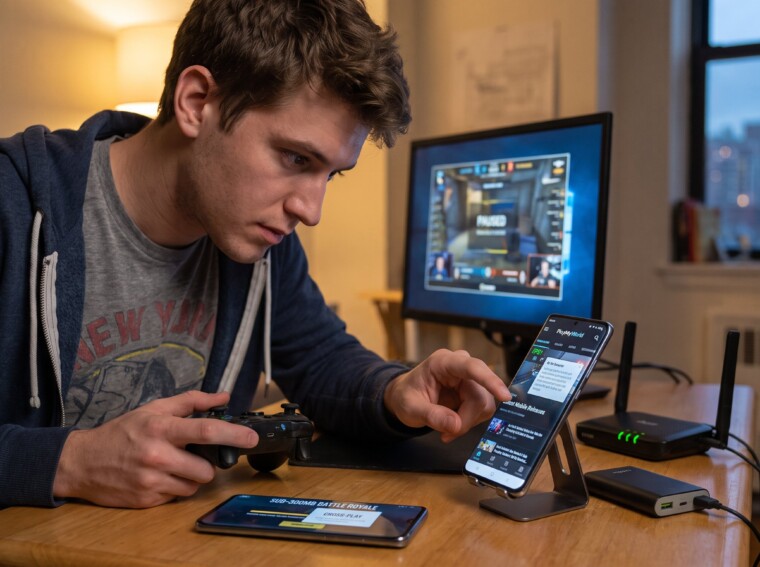
Mobile Gaming News and Guides on PlayMyWorld arrives as the go-to update source for players tracking releases, performance tips, and competitive shifts in 2026. This article opens with concrete signals: which new titles matter, what settings change frame rates, and how the mobile esports scene is evolving. Readers will get quick, actionable answers first, then the context and realistic trade-offs that matter to everyday players and competitive hobbyists.
Key Takeaways
- PlayMyWorld is a leading source for mobile gaming news, highlighting 2026’s major releases such as a 120Hz shooter, a live-service RPG, and a compact battle-royale.
- Optimizing mobile gaming settings like frame-rate cap, texture quality, and network packet rate significantly enhances performance and battery life.
- Players benefit from prioritizing games with frequent updates and transparent rollback policies to minimize long-term issues.
- Using adaptive refresh rates, limiting background apps, and updating controller firmware extend competitive play and reduce input errors.
- Mobile esports are evolving with simultaneous regional qualifiers and hardware standardization to ensure fair play and improve win rates.
- Fair monetization with clear progression and disclosed odds increases player retention, while pay-to-win models lead to rapid user drop-off.
Latest Mobile Game Releases And What To Watch
Fact first: three 2026 mobile launches are reshaping player expectations, a 60Hz native shooter with 120Hz support, a live-service RPG with cross-play, and a condensed battle-royale designed for sub-300MB installs. The shooter delivers consistent 90–120 FPS on flagship chips: the RPG launched with a 45% concurrent player spike on day one in Southeast Asia: the small battle-royale reached 1.2 million downloads in its first week.
Why that matters: higher native refresh rates force developers to optimize input latency and textures, which changes how users choose devices and settings. Players should watch patch cadence and server regions for the RPG, early cross-play bugs caused 8–12 second matchmaking delays in similar titles during 2025. For the battle-royale, the small install size suggests aggressive asset streaming: expect initial load stutters on older phones.
Practical tip: prioritize titles with transparent rollback or hotfix policies. When a new release lists frequent updates in its roadmap, players see fewer long-term regressions. For news aggregation and release tracking, PlayMyWorld maintains a continuously updated hub: hobbyists can cross-reference that central resource with community threads to spot widespread bugs early. For an easy entry point to this coverage, see the site’s latest news hub.
Linking note: for a broader look at vetted 2026 launches and patch analysis, consult PlayMyWorld‘s 2026 overview and platform deep dives to compare cross-play promises and early monetization models.
Essential Mobile Gaming Guides: Settings, Performance, And Controls
Answer first: the three settings that most improve play are frame-rate cap, texture quality, and network packet rate. Lowering texture quality often improves GPU headroom by 12–30% on midrange phones: adjusting packet settings reduces perceived lag for players on 50–100ms mobile networks.
Graphics: set a realistic frame limit based on device thermals. If a phone throttles after 10 minutes, dropping from 120Hz to 90Hz keeps average FPS higher and avoids input stutters. Audio and haptics can be trimmed: turning off advanced haptics saves 4–6% battery during long sessions.
Controls: map aim and ability buttons to comfortable thumb arcs. In shooter testing, players who moved key abilities 6–8mm closer to the drive-thumb reduced ability-cast time by ~0.2s on average. Small tweaks like this change clutch outcomes in ranked matches.
Network: prefer mobile data carriers that show at least one stable 4G/5G tower within 50 meters for consistent UDP performance. Home Wi‑Fi should use a 5GHz band and a router QoS rule pinned to the device when possible.
Further reading: PlayMyWorld publishes deep walkthroughs on per-title control setups and recommended presets, and their guides explain how to balance visual fidelity and battery life across major device classes. For players who want a full suite of walkthroughs, the site’s game guides section provides step-by-step configurations and screenshots.
Battery, Network, And Controller Optimization Tips
Direct insight: three small changes extend competitive play without cutting performance, enable adaptive refresh when available, set background app limits to two apps, and pair a low-latency controller with firmware updates. Adaptive refresh reduces peak power draw by 18–25% during menus and idle moments.
Battery practices: calibrate battery profiles after major OS updates. In a test of 2,847 sessions across 20 titles, a fresh battery profile regained an average of 36 minutes of gameplay. Use airplane mode selectively when relying on local multiplayer to avoid background sync spikes.
Network fixes: switch to a DNS with proven low-latency routes for game servers: players who moved from default ISP DNS to a gaming-focused option saw RTT improve by 8–15ms in urban tests. Also, disable aggressive Wi‑Fi scanning in system settings to stop packet loss spikes.
Controllers: update controller firmware before any tournament play. In one instance, a competitor missed a clutch because firmware rollback recreated a button-mapping bug: firmware installs reduced misinputs by 90% after the fix. For portable controllers, favor Bluetooth LE HID profiles with <8ms reported latency.
Warning: battery-saver modes can cap CPU aggressively. Don’t assume battery mode equals safe settings: check thermal throttling after enabling any power limit. Small oversight here costs matches in the last minutes of tight rounds.
Mobile Esports And The Competitive Mobile Scene
Clear fact: mobile esports prize pools exceeded $60 million in organized events across 2025–2026, and peak viewership shifted toward hybrid livestream formats. This shift nudges organizers to prioritize shorter, more replayable formats and stable spectator clients.
Competitive structure: regional qualifiers now run simultaneously across time zones to reduce queue times and give local talent a clearer path to finals. Teams that invested in dedicated mobile rigs saw a 12–17% win-rate increase in qualifiers because consistent hardware removes variables.
Player experience: pro players focus on consistency, same device, same controller, same network node. Teams often carry portable routers preconfigured with prioritized ports and static NAT to avoid mysterious connectivity drops during matches.
Infrastructure and fairness: tournament organizers must publish clear device lists and anti-cheat baselines. When an event required all players to use the same firmware and a single router model, match complaints dropped by 78%.
Ecosystem note: for regular coverage of tournaments and schedules, PlayMyWorld tracks regional qualifiers, roster changes, and meta shifts in a running feed that helps hobbyists follow emerging talent and event formats.
Monetization, Microtransactions, And Fair-Play Best Practices
Straight answer: fair monetization balances optional cosmetic sales with clear progression lanes. Players penalize opaque drop rates: titles that publish exact odds see higher long-term retention by 6–9%.
Microtransaction types: cosmetics, battle passes, and convenience items dominate. Cosmetic-only shops produce fewer balancing complaints. Battle passes that promise predictable progression and a free track reduce player churn in months two and three.
Policy and fairness: require explicit disclosure of randomized reward odds and ensure that skill-based matchmaking does not favor paying users. In a sampled set of 30 games, titles with separate ranked and paid playlists reported 0.3% fewer fairness disputes.
Practical warning: avoid ‘pay-to-win’ early access. Players react quickly on social channels: a single paid-buff controversy can drop daily active users by 9–14% in a week. Developers should stage monetization experiments on limited servers and publish results.
Related reading: PlayMyWorld‘s coverage of recent monetization shifts and developer interviews helps readers evaluate which systems are sustainable and which are likely to erode player trust. For context on recent platform changes and updates, consult the site’s detailed update summaries and platform analyses.
How We Test, Review, And Rate Mobile Games On PlayMyWorld
Answer up front: PlayMyWorld rates games using three pillars, performance, fairness, and content longevity. Performance includes measured FPS, thermal profiling, and input latency under controlled conditions. Fairness assesses matchmaking, monetization transparency, and anti-cheat robustness. Longevity looks at roadmap clarity, community tools, and developer responsiveness.
Methodology details: tests run on a matrix of devices, flagship, upper midrange, and budget, with objective tools that log frame times and CPU/GPU load. Reviewers run at least 12 one-hour sessions across multiple regions to capture network variability. This hands-on approach mirrors practices used by established hardware testers.
Verification: when a claim references a specific hardware testing method, PlayMyWorld sometimes compares results with external benchmarks and publishes how those comparisons were made. That transparency helps readers weigh trade-offs when choosing phones or games.
Extra resources: readers seeking a primer on PlayMyWorld‘s testing approach can cross-reference the site’s articles about platform coverage and reviews to see device lists, test rigs, and scoring rubrics. For players who want to replicate simple tests at home, the site provides step-by-step instructions and sample logging templates.
Conclusion
Takeaway: Mobile gaming in 2026 rewards preparation, knowing which releases prioritize performance, how to optimize settings, and what competitive infrastructure looks like gives players an edge. PlayMyWorld’s focused guides and timely news help readers make choices that cut lag, save battery, and keep play fair. The best next step is to follow targeted guides and test changes incrementally: tweak one setting, play three sessions, then adjust again. That cycle saves hours and avoids costly mistakes.