
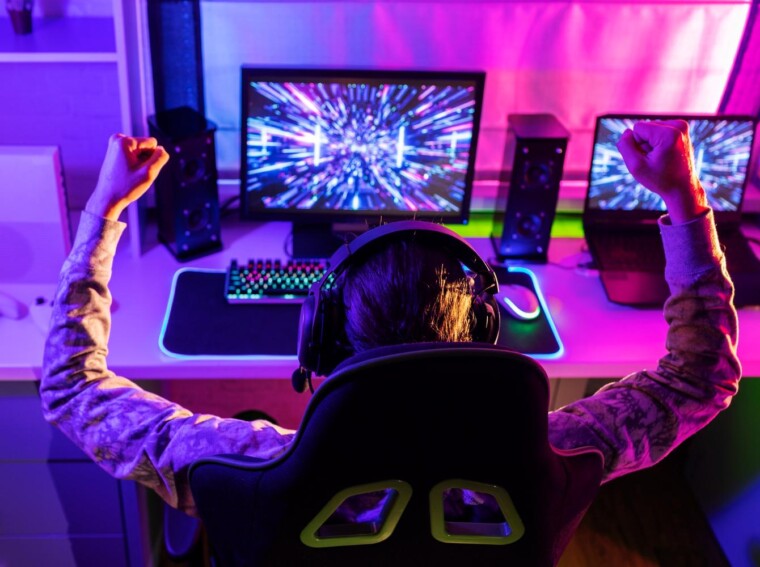
Gaming once required commitment. Players were often immersed in the game for hours, and once they started, there was room for pauses, but the gameplay itself was built on intense focus. SSD storage, suspend states, Rest Mode, and Xbox Quick Resume have changed that and allowed a more relaxed approach.
However, things are still changing. Instead of treating gaming as an event, many users now see it as a quick option between other parts of the day. It led to the invention of what’s called background gaming.
What Is ‘Background Gaming’?
Background gaming describes a simple behavioral change: players using console or PC games in short bursts whenever time appears. The practice was normalized in mobile gaming because it’s easiest to do on mobile devices, but is now done across all devices. Modern hardware allows you to pause and resume the game at any point without losing any of the experience. This shift has also influenced igaming software development, as developers increasingly focus on seamless cross-device performance and faster session recovery to match changing player habits.
It also changed how players approach individual games. Instead of playing a single game through its narrative, players may complete a challenge in Forza Horizon 5, then switch to a match in EA Sports FC 26, and later continue a mission in Halo Infinite.
Why Quick Resume Was More Important Than Many Expected
When new hardware is launched, most of the focus is on the graphics or the processing speed. Those are the upgrades that most impact the player’s experience of the game and that are advertised the most. Other features were mentioned, including the quick resume option, but most reviewers overlooked them. However, it’s this option that ended up changing the gameplay the most.
Older consoles often required full restarts, loading screens, publisher logos, and menu navigation every time a player wanted to switch titles. Once Microsoft recognized the potential of Quick Resume, it further improved the service and added new features that users could tinker with.
The real value was the convenience. Once starting and playing the game took seconds, players started playing more, and what’s more important, they started playing more games. This happened at the same time as players grew bored with complex AAA games and as the crypto gambling industry showed increasing interest in eSports. Experts such as those from CCN claim that wagering on eSports games with crypto makes transfers easier and less expensive. All of these games are better suited to the quick resume feature.
How Player Habits Are Changing
The new gameplay has affected player behavior. This is first noticeable in the session length. A short play window is now enough to be productive within a game. A player can log in for twenty minutes, complete a race, finish a challenge, or make progress in a campaign without wasting half the session loading menus.
Game rotation has also changed in the process. Players no longer commit to a title for months, but tend to play numerous games at once and do so at various stages of progress. There’s also a genre diversity we haven’t seen before. Players tend to move between sports games, shooters, RPGs, and live-service releases in the same week.
Subscription libraries have also benefited from the change. Players have access to these libraries via a monthly subscription, and instead of owning the games, they can switch through the roster. With increased interest in retro games, libraries have become even more popular, prominently featuring 20- or 30-year-old games remade for a new audience.
Which Genres Benefit Most?
There are genres that are better suited to this type of gameplay. Sports titles are perfect because matches are self-contained and quick. Racing games are also experiencing a boom, partly because of the new gameplay type, and partly because they’ve become especially advanced.
Roguelikes work well because each run offers clear progress in short bursts. Live-service games benefit from daily challenges, battle pass tasks, or short multiplayer sessions. There’s also an increase in interest in puzzle and strategy games, and especially those that are broken into manageable segments.
Other genres have shown mixed results so far. Long JRPGs with heavy cutscenes or slow openings can be harder to enjoy in tiny sessions. Such games were among the most popular AAA titles and game-of-the-year contenders. Deep management sims with many menus may also feel less accessible in short windows. However, with a robust autosave system, almost all games could be played this way.
The Future of Background Gaming
Gaming has shifted from a hobby that demanded undivided attention to one that can be integrated into daily life. Future systems will accommodate that change and evolve to enhance it further. They may include smarter suspend states across all platforms, with online games reconnecting seamlessly.
Game development will follow suit, with developers designing progress loops around 20-minute sessions rather than 2-hour marathons. Cross-device play is already a common feature, but it will expand and improve in the years to come. Time is one of the most important resources a person has, and the gaming industry is starting to treat it as such.